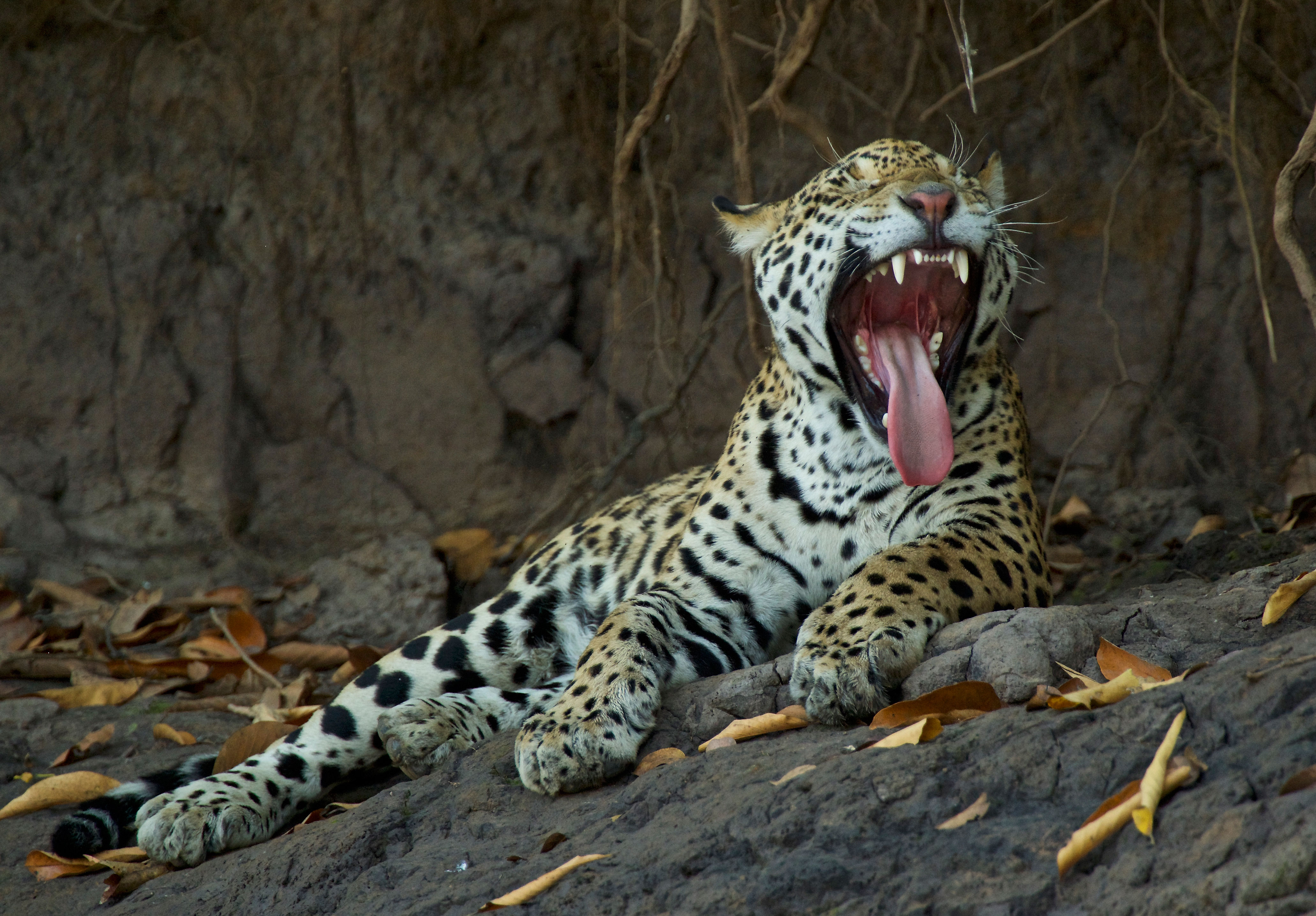
Once, the top predator in a large portion of the American continent, from Northern Patagonia to the SW of the USA, the Jaguar (Panthera onca), the third largest cat in the world, has seen its domain shrink to patches of tropical and sub-tropical forests, in central and South America.
Known as yaguarete (real ferocious beast) to the Guarani aboriginals, Nahuel to the Mapuche, tigre-tiger to the Spanish, Onca Pintada (Painted panther), this large cat, looks, for the uneducated eye, like a leopard on steroids.
Jaguars weigh more, have stockier bodies, and also the most powerful bite, allowing them to hunt reptiles such as turtles and caiman. They are not only not afraid of the water, but great swimmers and tend to stalk their prey on the riverbanks, sometimes capturing them while swimming or diving.
A good way to tell the difference between the Jaguar and the Leopard is that Jaguars have spots inside their spots. The spots on the Leopard are clear. Of course, this is only possible in pictures as there are no Jaguars outside the Americas and no Leopards outside of Africa and Asia. One of the things they have in common is that both are called “Black Panthers”, a species that does not exist, but is just a darker version of both Jaguar and Leopard, due to melanism, a genetical anomaly.
Males can weigh up to 130 kg with an average life span of 13 years. Females are smaller. They have 2-3 cubs after a gestation period of just a little over three months. Usually weaned after 3-4 months, the cubs remain with the mother, for over a year. Males patrol and fight for their territories, so it is not uncommon to see scarred and “fallen” faces, as they tend to hit and bite each other. As they get older, their collection of scars can be seen from far away.
They are lonely cats. Females tend to share territory with other females, but a male’s territory will cover a larger area, and if it finds another male, they will fight until the looser escapes or is killed. This not a minor factor, because, like other cats, it is hunted down by ranchers, and when a dominant male is killed, a few males will try to conquer its territory.
The jaguar has been hunted to near extinction in countries like Argentina, and the USA, and is only found, but hardly spotted in the jungle areas of most countries. It used to roam the grasslands too.
It is now a protected species in most countries, although poaching still happens pretty much everywhere. Something to point out is that the NGO Rewilding Argentina, after several years of breeding jaguars in captivity has released a few, into the marshes of Ibera, an area where it had disappeared.
Its main threat, and this is no surprise, is our species. Not only by directly killing them, but also by reducing and fragmenting their habitat. Fortunately, there are some strong NGOs working to protect it, in different countries. These NGO have purchased strategic patches of land that not only serve as buffer zones between the wild lands and the ranchers, but also areas which are adjacent to conservation areas, protecting the jaguar’s environment.
Jaguars tend to be crepuscular but will hunt during the day if the opportunity arises. When resting, they usually stay in the shade, and close to rivers or lakes, and sometimes just watch the water for any distracted animal. Caypbara (Hydrochoerus hydrochaeris), the largest rodent in the world, is one of its favorite preys. It lives in the wetlands and riverbanks, sometimes in large family groups. Of course, this means that several animals are better at being alert than lonely ones, so hunting capybara is not an easy task. The little ones are usually the ones that get captured. Tapir, marsh and pampas deer, anteaters and waterfowl are also part of the diet, and when jaguars become independent, and also when they age, they go after Yacare caiman (Caiman yacare), which are easier to catch. They will capture fish sometimes too. When hunting they stalk their prey and will chase them for a short distance, even diving and swimming.
lonely ones, so hunting capybara is not an easy task. The little ones are usually the ones that get captured. Tapir, marsh and pampas deer, anteaters and waterfowl are also part of the diet, and when jaguars become independent, and also when they age, they go after Yacare caiman (Caiman yacare), which are easier to catch. They will capture fish sometimes too. When hunting they stalk their prey and will chase them for a short distance, even diving and swimming.
For several years, and due to the transformation of cattle areas into conservation, the area of the Cuiaba River, and its tributaries, between Mato Grosso and Mato Grosso do Sul, in Brazil have become the best place to spot jaguar in the wild. There are other good areas, like Caceres, or the Paraguay River, but the population density and the adaption of the jaguar to human-boat presence, makes the area of Porto Jofre, probably the best in the world to photograph this cat.
Self-regulation of the different outfitters, has ordered, somehow, the at times chaotic rushes to see the cats. The boat drivers use their radios to let the others know what they have spotted, and sometimes the “sprints” to get to the jaguars became dangerous races. Luckily, the locals have realized that a live jaguar is much better than a dead one, for the whole community and recognize the species as a source of income. With a bit more of self-regulation, the locals and the jaguar can lead better lives in the area.
They can be seen all year around, although there is a rainy season, when the rivers flood the riverbanks. The sightings are still great, but it is hot and humid. Of course, you can also get wet, very wet.
In their “winter”, July-August, days are usually sunny, and the temperature is bearable. A typical day starts before the sunrise, getting on the boat and patrolling the rivers. As with any wild animal, some days are easier than others, and if luck is on our side, we might be looking at a jaguar just o ! the pier. Sometimes, it is a bit harder, and if you are shooting for behavior, you might be holding your camera and lens for a while, falling prey of horse flies, which have a sting, strong enough to perforate a caiman skin. Of course, it is, most of the time, very well compensated, as these cats, don’t usually sleep all day.
Sometimes they patrol to find their prey but sometimes, they just wait, and the prey come to them. When attacking, they can dive directly from a branch into a river, completely submerging themselves, and usually re-surfacing with its kill. When they succeed in their hunts, they usually go into the forest, taking their prey, to eat it, in privacy. Unfortunately, I have never seen them feed during the day, having to guess that they were in fact doing so.
On a hot day, we usually return to the lodge for lunch and some rest, returning in the afternoon to the river. Sometimes, we do all day “runs” as we might go far away up the river, or we just want more time.
The adventure does not end on the river, as we always have the chance to find jaguar on the world famous Transpantaneira road, and we sometimes take a ride in a truck, at dusk, with a flood light.
From a personal angle, I have to admit that I have never been intimidated by a puma, but jaguars are a different thing. Walking in the forest, or just making a comfort stop at the shore, is something we do with a lot of care. Or course, we find an open area, look carefully and then, try to do our business as fast as possible.
However, I also have to say that spotting one, under the cover of the forest, or just relaxing on a big branch, absolutely always makes my day. If I can witness a hunt, cubs or mating, the day is more interesting. I just love being on the river, waiting for something to happen, even with the horse flies and the heat.
Jorge is a wildlife photographer, naturalist and expedition guide. He has made innumerable trips throughout the world, focusing on wildlife and horseback rides. He has worked in the travel industry for over 30 years. Jorge has worked as a fixer for BBC, Nat. Geo and ZED. His photographs have been published in several scientific and...
By Kaitlyn Baker & Peter Hudson | Photos by Peter Hudson, Amith Krish, Prasanth Tatineni, Eric Seemann, Harshad K, Thomas Bretschneider Deepa Girish, Kaitlyn Baker, Vera Huston, Hermis Haridas, Manu Reghurajan, Gustavo Costa, and Nisha Purushothaman
PT Aware 10 Minutes read
ReadBy Ranjan Ramchandani | Photos by Ranjan Ramchandani
PT Explorers 10 Minutes read
ReadEmail: email@pawstrails.com